Showing posts with label mitral valve. Show all posts

Thursday, August 18, 2011

Approaches to Minimally Invasive Mitral Valve Repair


When doctors diagnose problems with the mitral valve (MV), May they consider it necessary to solve them surgically before your heart is held fixed oštećenja.MV located between the left atrium and ventricle. Its mission is to facilitate the flow of blood from the atria (upper chamber) to the chamber (lower chamber), while preventing backflow. Unfortunately, there are several circumstances that prevent him performing his job effectively.

For example, one of his two leaflets can be loose or unsupported. Or, flyers can be elastic, causing them to flop (a condition known as pelvic organ prolapse). When these problems are present, the surgeon may decide that a candidate for minimally invasive mitral valve repair. We will explain several approaches to your surgeon can take to repair the MV without cutting completely through the sternum.

A partial upper sternotomy

A partial upper sternotomy

...

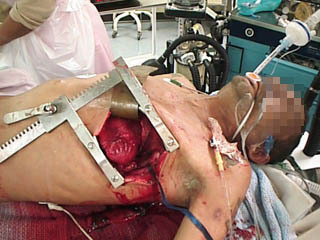
To be fair, partial upper sternotomy is not technically considered "minimally invasive" because it requires cutting the sternum. But it is far less invasive than conventional open chest surgery. Often used in cases where the patient needs to have both her aortic and mitral valves repaired.

Right Mini thoracotomy

The right mini-thoracotomy, the sternum is cut at all. Instead of an incision made in the middle of the chest, an incision is made ​​in your skin in the right prsima.Rez is usually three inches or less and allows the surgeon to insert the tools to approach the MV rebra.Potrebne repairs can be performed without the surgeon to directly access the heart.

robot-assisted mitral valve repair

This is a newer approach to minimally invasive mitral valve popravak.Kirurg will make a few incisions in the right chest. Two sections will be very small - two or three centimetra.Treći cut will be measured less than three inča.Kirurg will insert the robot arm through the small incisions. On the arms control computer, while watching the video monitor.Ruke sites are equipped with the necessary tools to slice through the pericardium and perform repairs.

approach, your surgeon decides that it will depend on the type of surgery you need, which valves are affected, how advanced the condition and the available tools. Minimally invasive mitral valve repair, although more widespread, it remains to be established in all hospitals. As always, consult with your doctor to discuss your surgical options.

Sunday, August 14, 2011

Common Questions About Minimally Invasive Mitral Valve Repair


Your mitral valve is located between the heart the left atrium and left ventricle. It regulates blood flow between the two chambers. As the electrical signals from the sinus node causes the atrium contracts, the valve opens to allow blood flow to the ventricle. Then it closes again, seal the opening and prevent backflow.

It may malfunction due to stenosis or regurgitation. Stenosis is characterized by narrowing of the valve opening, which restricts the blood from flowing through. Regurgitation is defined as a leak. In any case, the surgeon may recommend a minimally invasive mitral valve surgery (MIMVS) repair. Below, we answer four questions that patients frequently ask about work.

To be distinguished from open chest surgery?

Many years ago, the operation is accomplished by opening the patient prsima.Dugi cut (ie, 6 to 8 inches) is made and a surgical saw was used to share prsne.Pacijent the heart should be stopped during the procedure, especially the heart-lung machine was used for blood circulation.

minimally invasive approach can be performed without division of the chest or stopping the heart. Instead, several small incisions in the right flank pacijenta.Kirurg accessing the site through the ribs and mitral valve repair is performed through incisions.

What are the risks?

As with any type of chest surgery, the risk of infection and blood loss during MIMVS. However, these risks are considerably greater during and after open thoracotomy.

receives a better replacement?

Whenever possible, the surgeon will choose to repair the malfunctioning mitral valve, but it zamijeniti.Razlog is because the presence of foreign material (in this case, the artificial valve replacement) within your body sharply increases the risk of infection and clotting. This is why patients who receive replacement heart valves are usually required to anticoagulants for the rest of your life.

That said, there are circumstances in which the valve is damaged to the point needed to be replaced. Moreover, in some cases, the surgeon may lack the necessary skills to effectively perform mitral valve repair surgery.

What happens after surgery?

the recovery process for minimally invasive mitral valve repair is shorter and easier than recovering from open thoracotomy. Since the sternum is not divided access to the heart, there is less likelihood of infection and blood loss. Postoperative pain is reduced and you will be released from the hospital in less time. And finally, scarring is limited to small incisions between your ribs.

Fortunately, a minimally invasive mitral valve repair is used in many hospitals and surgical teams more than ever. Its growing importance in leading hospitals provide significant benefits for the patient with regard to this type of surgery.